Repository Exclusive Hot!: Conan

To understand the term, we must first break it down. In Conan, a repository (often called a "remote") is a server that stores Conan packages (collections of binaries, source code, and metadata). An exclusive in this context refers to a locking mechanism or a routing directive that forces Conan to look for—or store—a specific package recipe or binary in , ignoring all others.

Conan does not have a built-in --exclusive flag, but through remote management, configuration, and lockfiles. For most teams, a default remote order with fallback is sufficient. However, for regulated or air-gapped environments, reducing to a single remote or using allowed_packages in Conan 2.x provides the strongest exclusive guarantee.

To enforce an exclusive repository policy, you must configure both your Conan server registry and your local client machines. Below is a guide based on Conan 2.x. Step 1: Remove Default Public Remotes

Use this scenario when you want your Conan client to connect to repository (e.g., an internal Artifactory) and ignore public repositories like Conan Center. conan repository exclusive

: Once a package version (e.g., MyEngine/1.2.0@company/stable ) is uploaded, it is locked. This prevents the "breaking change" disaster where a library is updated or deleted unexpectedly, which could halt production.

The Conan Repository Exclusive is a game-changer for C/C++ package management. By providing package creators with a simple, secure, and streamlined way to manage their packages, Conan is poised to revolutionize the way we manage C/C++ packages. As the C/C++ landscape continues to evolve, the importance of efficient and reliable package management will only continue to grow. With the Conan Repository Exclusive, package creators and users alike can benefit from a more integrated, secure, and user-friendly experience.

Specifically, this concept is most relevant when discussing or Conan Center Index policies regarding "exclusive" package hosting. To understand the term, we must first break it down

The is not a limitation—it is a liberation from entropy. In a world where supply chain attacks are rising and binary compatibility is fragile, knowing exactly where each lib.so or .dll originated is paramount.

, p

: A popular alternative to Artifactory, Nexus supports "hosted" Conan repositories (for your own binaries) and "proxy" repositories (to cache ConanCenter). Conan does not have a built-in --exclusive flag,

"Only use this remote for packages that strictly belong to it. Do not allow fallback to other remotes for these specific packages."

To maximize the value of an exclusive Conan repository, adopt these best practices:

: For open-source libraries (e.g., Boost, OpenSSL). Private Remote : For proprietary internal libraries.
Command line utility

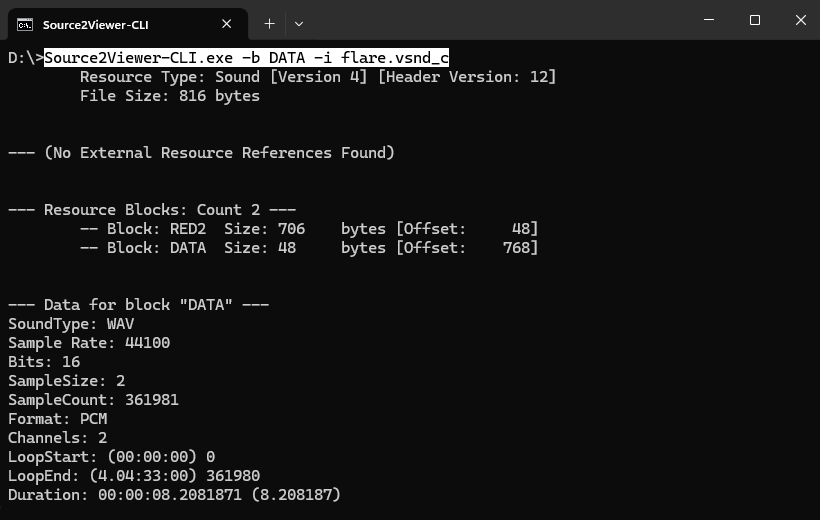
A cross-platform console application that can export and decompile Source 2 resources similar to the main application.

ValveResourceFormat

.NET library that powers Source 2 Viewer (S2V), also known as VRF. This library can be used to open and extract Source 2 resource files programmatically.

ValveResourceFormat.Renderer

.NET library providing an OpenGL-based rendering engine for Source 2 assets. Standalone rendering of models, maps, particles, animations, lighting, and materials with physically-based rendering (PBR).

ValvePak

.NET library to read Valve Pak (VPK) archives. VPK files are uncompressed archives used to package game content. This library allows you to read and extract files out of these paks.

ValveKeyValue

.NET library to read and write files in Valve key value format. This library aims to be fully compatible with Valve's various implementations of KeyValues format parsing.

C#
// Open package and read a file
using var package = new Package();
package.Read("pak01_dir.vpk");

var packageEntry = package.FindEntry("textures/debug.vtex_c");
package.ReadEntry(packageEntry, out var rawFile);

// Read file as a resource
using var ms = new MemoryStream(rawFile);
using var resource = new Resource();
resource.Read(ms);

Debug.Assert(resource.ResourceType == ResourceType.Texture);

// Get a png from the texture
var texture = (Texture)resource.DataBlock;
using var bitmap = texture.GenerateBitmap();
var png = TextureExtract.ToPngImage(bitmap);

File.WriteAllBytes("image.png", png);
View API documentation
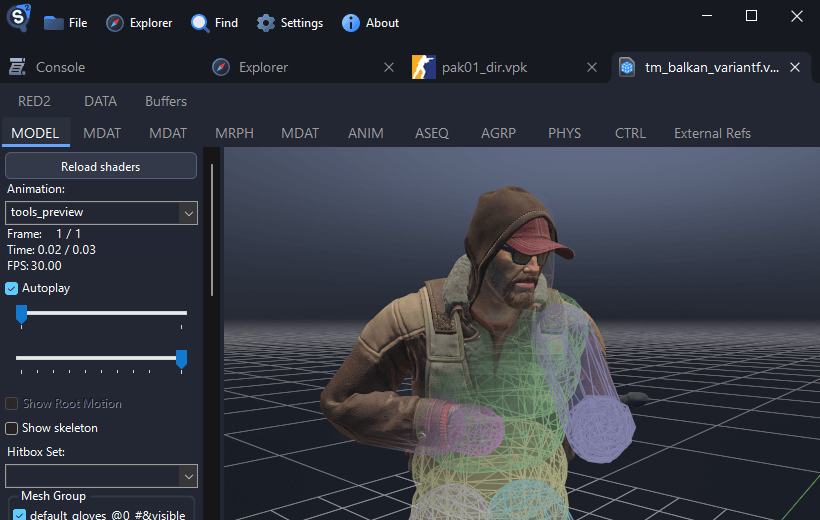
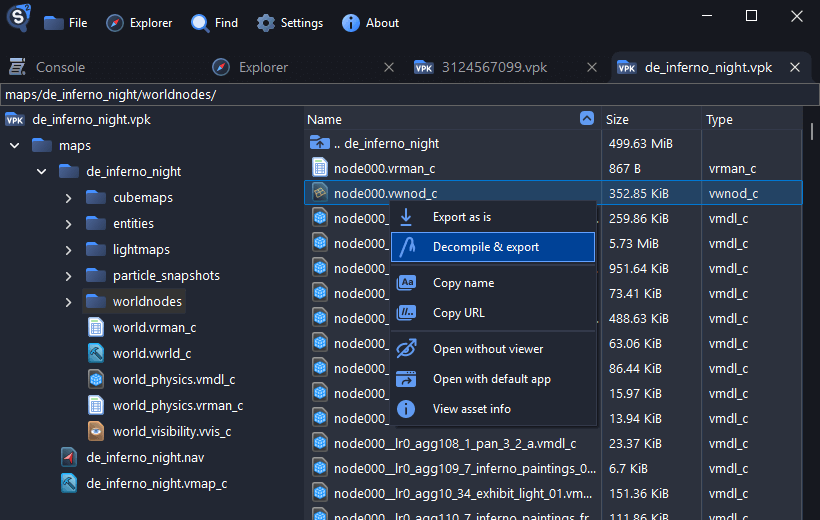
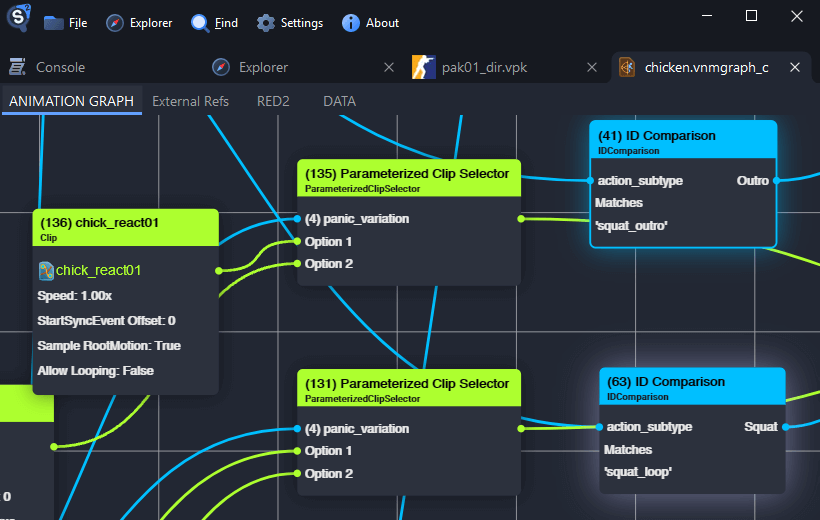
Screenshot of the 3D renderer displaying a Counter-Strike 2 player model on a grid Screenshot showing the VPK package explorer interface with a file tree and a list view Screenshot of the animation graph viewer showing nodes Screenshot of the command line interface showing DATA block for an audio file

To understand the term, we must first break it down. In Conan, a repository (often called a "remote") is a server that stores Conan packages (collections of binaries, source code, and metadata). An exclusive in this context refers to a locking mechanism or a routing directive that forces Conan to look for—or store—a specific package recipe or binary in , ignoring all others.

Conan does not have a built-in --exclusive flag, but through remote management, configuration, and lockfiles. For most teams, a default remote order with fallback is sufficient. However, for regulated or air-gapped environments, reducing to a single remote or using allowed_packages in Conan 2.x provides the strongest exclusive guarantee.

To enforce an exclusive repository policy, you must configure both your Conan server registry and your local client machines. Below is a guide based on Conan 2.x. Step 1: Remove Default Public Remotes

Use this scenario when you want your Conan client to connect to repository (e.g., an internal Artifactory) and ignore public repositories like Conan Center.

: Once a package version (e.g., MyEngine/1.2.0@company/stable ) is uploaded, it is locked. This prevents the "breaking change" disaster where a library is updated or deleted unexpectedly, which could halt production.

The Conan Repository Exclusive is a game-changer for C/C++ package management. By providing package creators with a simple, secure, and streamlined way to manage their packages, Conan is poised to revolutionize the way we manage C/C++ packages. As the C/C++ landscape continues to evolve, the importance of efficient and reliable package management will only continue to grow. With the Conan Repository Exclusive, package creators and users alike can benefit from a more integrated, secure, and user-friendly experience.

Specifically, this concept is most relevant when discussing or Conan Center Index policies regarding "exclusive" package hosting.

The is not a limitation—it is a liberation from entropy. In a world where supply chain attacks are rising and binary compatibility is fragile, knowing exactly where each lib.so or .dll originated is paramount.

, p

: A popular alternative to Artifactory, Nexus supports "hosted" Conan repositories (for your own binaries) and "proxy" repositories (to cache ConanCenter).

"Only use this remote for packages that strictly belong to it. Do not allow fallback to other remotes for these specific packages."

To maximize the value of an exclusive Conan repository, adopt these best practices:

: For open-source libraries (e.g., Boost, OpenSSL). Private Remote : For proprietary internal libraries.
Changelog

Made possible by amazing people

Source 2 Viewer is open-source and built by volunteers. Every contribution helps make it better for everyone.