Olly, the author of OllyDbg, presents his new open source joke:

PAPERBACK v1.10


Updated by Michael Mohr

Download PaperBack v1.10
Download sources v1.10

PaperBack version 1.00 does not implement AES encryption properly.  Specifically:

a) The key used for (en|de)cryption in version 1.00 provides at most an effective key strength of less than 50 bits (and likely far less, perhaps on the order of 15-25 bits, depending on password quality) instead of the expected 256 bits.  Version 1.10 derives the encryption key from the password via key stretching, significantly improving key strength.  This change causes a small delay in the encryption step.

b) PaperBack version 1.0 implements ECB mode symmetric encryption.  This mode is subject to a watermark attack and leaks information about the encrypted data.  Version 1.00 changes the encryption mode to CBC, which mitigates this attack.

2) AES key length is now selectable in paperbak.h via AESKEYLEN.  I suggest not using AES-256, as its key schedule is known to be substandard.  See Bruce Schneier's website for details.  For the moment I've switched PaperBack to use AES-192.

3) The included libraries are now packaged as binary .lib files.  Instructions for rebuilding them from source are included in README.md from the PaperBack source code.

(Olly: mea maxima culpa. I am no cryptanalytic, and wrote Paperback quickly and without much thinking about the strength of the code. Btw, can this new release read old bitmaps?)


PAPERBACK v1.00

Download PaperBack v1.00
Download sources v1.00
Read GNU GPL


1. What is PaperBack?
2. Installation.
3. Setup.
4. Printing data to paper.
5. Data restoration.
6. History.
7. Patents and IP.
8. Acknowledgements.

9. Source code description.


1. What is PaperBack?

PaperBack is a free application that allows you to back up your precious files on the ordinary paper in the form of the oversized bitmaps. If you have a good laser printer with the 600 dpi resolution, you can save up to 500,000 bytes of uncompressed data on the single A4/Letter sheet. Integrated packer allows for much better data density - up to 3,000,000+ (three megabytes) of C code per page.

You may ask - why? Why, for heaven's sake, do I need to make paper backups, if there are so many alternative possibilities like CD-R's, DVD±R's, memory sticks, flash cards, hard disks, streamer tapes, ZIP drives, network storages, magnetooptical cartridges, and even 8-inch double-sided floppy disks formatted for DEC PDP-11? (I still have some). The answer is simple: you don't. However, by looking on CD or magnetic tape, you are not able to tell whether your data is readable or not. You must insert your medium into the drive (if you have one!) and try to read it.

Paper is different. Do you remember the punched cards? EBCDIC and all this stuff. For years, cards were the main storage medium for the source code. I agree that 100K+ programs were... unhandly, but hey, only real programmers dared to write applications of this size. And used cards were good as notepads, too. Punched tapes were also common. And even the most weird codings, like CDC or EBCDIC, were readable by humans (I mean, by real programmers).

Of course, bitmaps produced by PaperBack are also human-readable (with the small help of any decent microscope). I'm joking. What you need is a scanner attached to PC. Actual version is for Windows only, but it's free and open source, and there is nothing that prevents you from porting PaperBack to Linux or Mac, and the chances are good that it still will work under Windows XXXP or Trillenium Edition. And, of course, you can mail your printouts to the recipients anywhere in the world, even if they have no Internet access or live in the countries where such access is restricted by the regiment.

Oh yes, a scanner. For 600 dpi printer you will need a scanner with at least 900 dpi physical (let me emphasize, physical, not interpolated) resolution.

Have I already mentioned that PaperBack is free? I release it under the GNU General Public License, version 3. This means that you pay nothing for the program, that the sources are freely available, and that you are allowed - in fact, encouraged - to modify and improve this application.


2. Installation.

You don't need to install PaperBack. Copy it to any directory, if possible, with unrestricted write access (to allow PaperBack to save settings to the initialization file), optionally create shortcut on the desktop - that's all.


3. Setup.

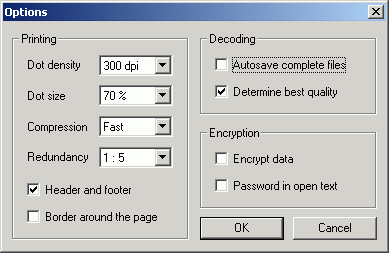
This is how Options dialog looks:

Options dialog


The most important setting is the dot density. It determines the size of the data bit on the paper and must be at least two times lower than the physical resolution of your printer. For example, if you are the (moderately) happy owner of the HP LaserJet V with 600 dpi resolution, set density to 300 dpi. This allows you to draw 300x300=90,000 dots, or slightly less than 6 k bytes of useful data on every square inch of the paper.

Jet printers are not as good as laser. Maximal useful resolution is typically limited to 200 dpi. Please select the best available quality, and don't forget to align the printing nozzles, so that points printed from left to right coincide with those printed from right to left.

Dots must be clearly distinguishable from each other. Usually this means that they must be separated by some anount of white space, determined by the parameter dot size. 70% is usually the best option.

Compression is always good, because it reduces the size of the bitmap, unless your file is already packed. Use fast compression if your computer is really, really slow, and maximal compression in all other cases.

Redundancy helps to recover partially damaged data. Redundancy 1:5 means that for every 5 consecutive data blocks, if one block is completely unreadable, PaperBack will be able to restore it. To reduce damages caused by coffee pots and other common dangers, blocks are distributed around the page. Higher redundancy decreases page capacity but improves reliability.

Header and footer asks PaperBack to print useful information about the file, like file name, its size, date of last modification, page and recommended scanner settings. This parameter influences only the printing and has no influence on the reading of the data. Border around the page improves autocropping with the not-so-smart TWAIN drivers.

Large files will be printed on several pages. When last page is scanned (order is not important) and autosave option is activated, PaperBack will ask you to select location where restored file will be saved. If this option is unchecked, you must press Save button when recognition is finished - convenient if your scanner has automatical feeder and you scan several backups (up to 5) at once.

PaperBack uses Highly Sophisticated Unbelievably Advanced Error Correction Techniques (in fact, Reed-Solomon ECC) to restore unreadable pixels. Therefore, if data is halfway readable, it will accept it, even if recognition parameters are very far from optimal. This accelerates processing but leads to the high amount of bad blocks reported by the program. When you backup important data and verify it afterwards, this may lead to false assumption that data is unreliable. But activate Determine best quality, and PaperBack will report the real data quality. Of course, this costs time.

Two last options set data encryption (FIPS-197 compliant AES is not easy to crack) and whether password is displayed as the readable text while you type it in, or the characters are replaced by asterisks. Of course, this option does not mean that password will be printed on the paper!


4. Printing data to paper.

First, set page size and printer options. They may differ from one driver to another, so I will not discuss them here in details. Always select the best available printing quality. Turn off halftoning, dithering and image optimization. Don't forget to align nozzles on jet printers; if possible, turn off bidirectional printing. Note that only basic printer options are saved between the sessions, and you may need to re-enter them again.

After options are set, you can print your data. Current PaperBack version is 1.00, and it can't backup folders - only the single files, at most one per page. This is the very substantial drawback for the backup program. If you are going to save many small files, better first pack them into the single archive using WinZip, tar or similar program.

PaperBack supports drag-and-drop. If file has extention other than .bmp, it will be printed. Default action for bitmaps is the recognition. To  backup them, use Print button. You can drop several files at once; internal queue is limited to 128 entries. Again, each file will be printed on the separate sheet(s) of paper.

For test purposes, you can save bitmaps to the disk. This option is selectable from the main menu.


5. Data restoration.

PaperBack should support any scanner with TWAIN interface. It also accepts uncompressed grayscale and RGB bitmaps with 8 or 24 bits per pixel. You can drag-and-drop files with extention .bmp directly into the PaperBack.

If you use scanner, select scanning source from the main menu, then press Scan button. Optimal resolution is about 3 times the dot density. B/W scans are usually unreadable, always select grayscale image. Color scanning is also acceptable, but has no advantages except for 3-fold memory use. (Another joke). Memory requirements are relatively high. A4 grayscale bitmap with 900 dpi resolution requires around 80 MB.

Turn off all image optimizations, like sharpening - PaperBack uses its own optimization techniques better suitable for this particular case.

Grid should be more or less parallel to the sides of the scanner (maximal angle must not exceed ±7°), but general orientation is unimportant: portrait, landscape, upside down or even, if you use transparencies, flipped. Orientation may change from one paper sheet to another.

You can scan up to 5 backups simultaneously. Each file will be placed into the separate tab. If backup consists of several pages, the order in which they are scanned is absolutely unimportant. Bottom line in the tab displays list of unscanned or incomplete pages. If some page is unreadable, change its placement, resolution and/or brightness and contrast.

Quality map to the right shows distribution of errors on the last scanned page as a gradations of colours. Good blocks are green. The higher the number of erroneous bytes, the more reddish is the colour. Undeciphereble blocks with more than 16 invalid bytes are black. If block is white, PaperBack was unable to recognize the grid. Doubleclick map to display the block as a grayscale image (optionally with marked errors).

After all pages are scanned, press on Save to write restored file to the disk. If backup is encrypted, you will be asked to enter the password.


6. History.

Once upon a time, my oldest son (he was 15 then) asked me: "Dad, how the huge amounts of data are saved on the small CD?" A brief explanation from my side followed, I took a very sharp pencil and tried to draw as small points and lines as possible, in order to emphasize how dense the data is. Then my son asked: "How much data can you place this way on the single sheet of paper?" My estimation was in the order of 100 K. "Can we make a try?" It took me four or five days to make the proof of concept, and another two weeks to integrate packer, encryption and user interface. Then I lost the interest and put the whole project into the darkest corner of the deepest directory on my hard disk. (One more joke). But why keep potentially useful code to myself? So now I am releasing it under GPL 3.


7. Patents and IP.

PaperBack is a "clean-room" implementation. I assure that my part of code is written by myself alone and is not based on any 3-rd party work.

However, I can't guarantee that this program doesn't infringe any patents, trade marks or other stuff that makes lawyers rich. If you are going to use PaperBack, all the burden of proof is on your side.

To make lawyers (un)happy:

Mortal Kombat 9 Ppsspp Iso Download Better For Android Isoroms Better -

While there is no official (2011) release for the PlayStation Portable (PSP), the gaming community has bridged this gap through extensive modding. If you are looking for the best way to experience MK9 aesthetics and characters on your Android device using the PPSSPP emulator, you are likely seeking a "Total Conversion Mod". The Reality of Mortal Kombat 9 on PPSSPP

The Truth About Mortal Kombat 9 PPSSPP ISO Download for Android: Why Safer Alternatives Are Better

Always remember that downloading copies of games you do not owned is technically unauthorized. Players choosing to download files should prioritize community-vetted hubs or verified developers to avoid security risks like malware or corrupted files. Step-by-Step Installation Guide for Android

It is important to manage expectations. The official Mortal Kombat 9 was released for PS3, Xbox 360, and PS Vita. The "PPSSPP ISO" versions available online are typically of Mortal Kombat: Unchained (the PSP version of MK: Deception). These mods replace textures and UI elements to mimic the look and feel of MK9. While not a 1:1 port, they offer the closest possible experience for PSP emulator users. Are you experiencing lag or audio stuttering ? While there is no official (2011) release for

user wants a long article about "mortal kombat 9 ppsspp iso download for android isoroms better". I need to follow the search plan. First, I'll gather information about PPSSPP, ISO Roms, compatibility, performance, setup, and legality. I'll search for various keywords to get a comprehensive view. search results provide a mix of information. I'll open some of the more relevant links to gather detailed information on downloading, settings, website safety, and cheats. search results provide a good amount of information. I will now synthesize this into a comprehensive article. The article will cover the game, PPSSPP, downloading, safety, setup, performance, cheats, and legality. I'll also need to address the "isoroms better" part by comparing different sources. I'll structure the article with an introduction, sections on the game and emulator, download safety, setup, performance tuning, cheat codes, PPSSPP Gold vs free, legal and ethical considerations, and a conclusion. you are a fan of classic fighting games, playing Mortal Kombat 9 on your Android device is an exciting prospect. The secret lies in the powerful PPSSPP emulator, but the journey is filled with questions about where to find the best ISO files and how to get the best performance. This long-form article serves as your ultimate guide to everything you need to know about downloading, setting up, and optimizing MK9 on your Android phone using the PPSSPP emulator, while also navigating the legal and safety issues.

If you own Mortal Kombat 9 (Komplete Edition) on PC, you can stream the game directly to your Android device with zero lag over a local Wi-Fi network using apps like or Steam Link . This gives you maximum graphics settings and flawless performance because your PC handles the heavy lifting. The Official Mortal Kombat Mobile Game

Using highly optimized ISO files alongside custom save data and texture packs allows you to bypass hardware limitations, delivering a flawless 60 FPS fighting experience directly to your smartphone. Understanding the MK9 PPSSPP Setup The "PPSSPP ISO" versions available online are typically

PlayStation Vita (As Mortal Kombat: Unchained was for the original PSP, the 2011 MK9 game was ported to the newer Vita handheld) Microsoft Windows (PC) What are the "MK9 PPSSPP ISO" Files Found Online?

The Reality Behind Mortal Kombat 9 PPSSPP ISO Downloads for Android

To play an MK9-themed mod safely on your Android device, follow these steps: The article will cover the game

Mortal Kombat 9 PPSSPP ISO Download for Android: Is ISORoms Better?

Like many ROM sites, files are often mislabeled with clickbait titles (such as calling a modded PSP game "Mortal Kombat 9") to drive search traffic.


8. Acknowledgements.

PaperBack would be not possible without the Reed-Solomon error correction. The code is written by Phil Karn (C) 2002. Phil allows use of his code under the terms of GPL.

AES encryption code is developed by Christophe Devine (C) 2001-2004. This code is also released under GPL.

bzip2 compression engine is developed by Julian R. Seward (C) 1996-2005. See sources for details. To my best knowledge (IANAL), his license is compatible with GPL.


9. Source code description.

There is currently none, but the sources are commented. If you need help, read comments. If you still need help, ask your friends. For more help, visit some discussion forum. If you are completely despaired, create your own forum. If you are ready to commit suicide, well, drop me a mail (ollydbg at t-online de). Set subject to PaperBack, or you will be considered spam and filtered out. Allow 4 to 6 weeks for delivery.


Visitors so far: Counter hostet by EUserv

This site is Copyright (C) 2007 Oleh Yuschuk, ollydbg at t-online de. You are allowed to cite and mirror it in whole or in parts, provided that you always refer to the original source.