Peter's electronic projects Peter's electronic projects
Within these communities, a specific type of content has gained popularity: amateur exclusives. This type of content typically features individuals who are not professional performers or models but are instead ordinary people who create and share content as a hobby or to express themselves.
is your chance to shine, showcase your skills, and connect with like-minded people in a supportive and inclusive environment.
We're excited to announce an event, open to all talented transgender individuals!
If you're looking for information on creating content or engaging with a community around a specific topic, it might be helpful to look into resources or forums dedicated to that subject. Always prioritize safety, legality, and respect in your content creation and consumption.
Amateur transgender modeling involves individuals who are not professional models but still want to share their photos, stories, and experiences online. These models often create content in a casual setting, using their own equipment, and share it on various social media platforms or specialized websites.
There are countless articles and resources available online on a wide range of subjects. If you have a specific topic in mind, I can help you find information or suggest where you might look.
Mainstream, studio-produced trans adult films have historically been criticized for casting cisgender actors (non-trans people) or for coercing performers into scripts that play into violent or degrading tropes. Amateur content, by contrast, features real trans people in their own homes, using their own boundaries, and often their own camera equipment.
 Try it now, before building! Click on the transmitter buttons with the
green
labels
on the left and see how the receiver outputs (K1-K8) change. Change
the number of transmitter or receiver channels. Switch the receiver
output type between latched and momentary.
Try it now, before building! Click on the transmitter buttons with the
green
labels
on the left and see how the receiver outputs (K1-K8) change. Change
the number of transmitter or receiver channels. Switch the receiver
output type between latched and momentary.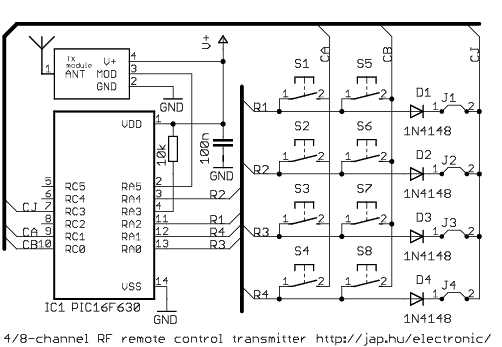
| part | description |
| C1 |
100nF ceramic capacitor |
| R1 |
10k resistor (1/8W) |
| D1-D4 | 1N4148 diode (optional) |
| S1-S8 |
tact switch, DTSM 61N or similar |
| IC1 | PIC16F630 or PIC16F676 microcontroller, pre-programmed |
| TXMOD |
radio
transmitter module, see text (hardware) |
| B1 |
battery between 2-5.5VDC (check TXMOD specs for valid voltage range) |
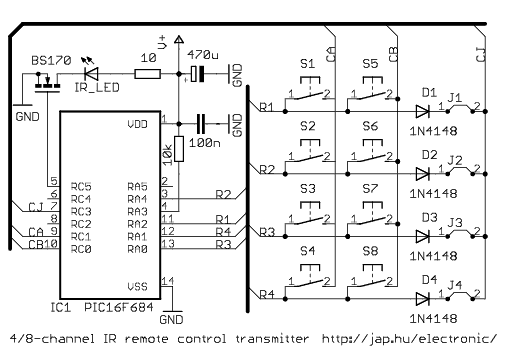
| part | description |
| C1 |
100nF ceramic capacitor |
| C2 |
470 uF 6.3V, electrolytic
capacitor |
| R1 |
10k resistor (1/8W) |
| R2 |
10 ohm resistor (1/4W) |
| D1-D4 | 1N4148 diode (optional) |
| D5 |
IR transmitter LED |
| Q1 |
BSS138 or similar N-MOSFET |
| S1-S8 |
tact switch, DTSM 61N or similar |
| IC1 | PIC16F684 microcontroller, pre-programmed |
| B1 |
battery between 2-5.5VDC (CR2032, 3.6V LiIon battery or 3xAA
batteries) |
| please
observe the corresponding address configuration! |
|
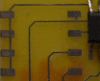 transmitter: no diodes connected |
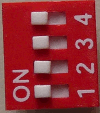 receiver: switches all ON |
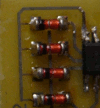 transmitter: all diodes connected |
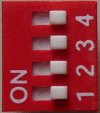 receiver: switches all OFF |
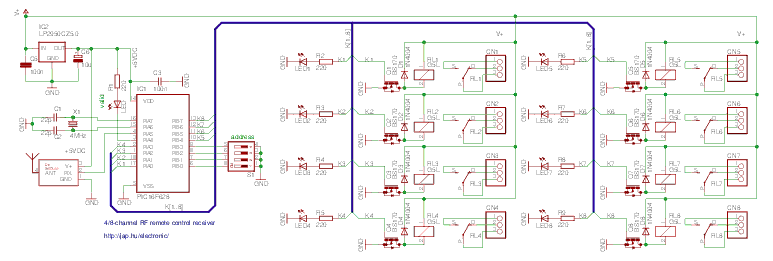
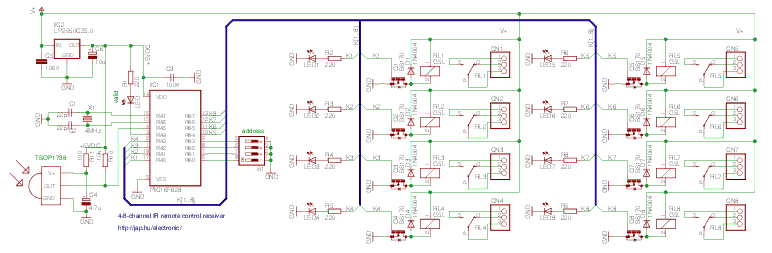
parts list
| part | description |
| C1, C2 | 22pF ceramic capacitor |
| C3, C5 | 100nF ceramic capacitor |
| C6 | 10uF 6.3V electrolytic capacitor |
| CN1-CN8 | PCB terminal block, 3-way (DG301) |
| D1-D8 | 1N4004 diode |
| IC1 | PIC16F627 or PIC16F628 or PIC16F627A or PIC16F628A microcontroller, pre-programmed |
| IC2 | LP2950CZ5.0 voltage regulator |
| LED | 3mm LED (green) |
| LED1-LED8 | 3mm LED (red) |
| Q1-Q8 | BS170 N-channel mosfet transistor |
| R1-R9 | 220R resistor (1/8W) |
| RL1-RL8 | G5LE relay, see text for coil voltage selection |
| S1 | piano DIP switch, 4-way |
| X1 | 4MHz HC49 crystal |
| RXMOD | 3-pin radio receiver module, see text (hardware) |
| please
observe the corresponding address configuration! |
|
| transmitter: no diodes connected |
receiver: switches all ON |
| transmitter: all diodes connected |
receiver: switches all OFF |
Within these communities, a specific type of content has gained popularity: amateur exclusives. This type of content typically features individuals who are not professional performers or models but are instead ordinary people who create and share content as a hobby or to express themselves.
is your chance to shine, showcase your skills, and connect with like-minded people in a supportive and inclusive environment.
We're excited to announce an event, open to all talented transgender individuals!
If you're looking for information on creating content or engaging with a community around a specific topic, it might be helpful to look into resources or forums dedicated to that subject. Always prioritize safety, legality, and respect in your content creation and consumption.
Amateur transgender modeling involves individuals who are not professional models but still want to share their photos, stories, and experiences online. These models often create content in a casual setting, using their own equipment, and share it on various social media platforms or specialized websites.
There are countless articles and resources available online on a wide range of subjects. If you have a specific topic in mind, I can help you find information or suggest where you might look.
Mainstream, studio-produced trans adult films have historically been criticized for casting cisgender actors (non-trans people) or for coercing performers into scripts that play into violent or degrading tropes. Amateur content, by contrast, features real trans people in their own homes, using their own boundaries, and often their own camera equipment.
LATCH_MASK EQU B'00001111' sets channels 8-5 to momentary
and
channels 4-1 to latched (toggle) mode. Then use the compiler (MPLAB or
gputils) to
assemble the code.clrf
0x91 ;
ANSEL